Private Label Underwear Manufacturing: The Complete Guide for Brand Owners
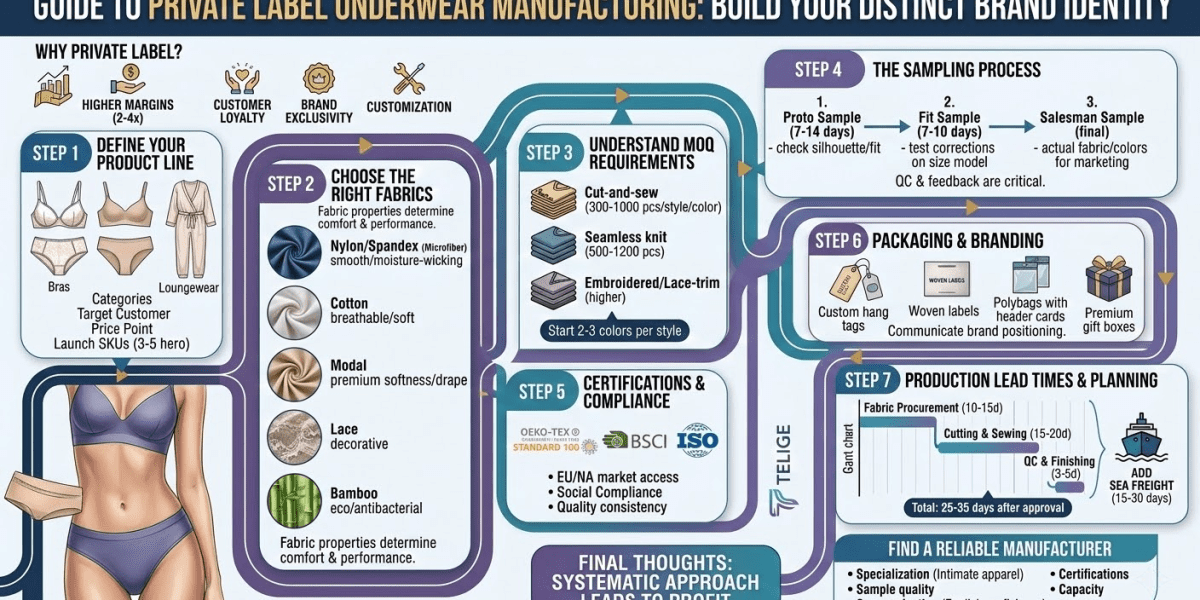
Private label underwear manufacturing is one of the most profitable paths for fashion entrepreneurs and retailers looking to build a distinct brand identity. Rather than reselling existing products, you create underwear that carries your own label — designed to your specifications, made by an experienced factory.
In this guide, we walk through everything you need to know: from what private label actually means, to how to find the right manufacturer, manage sampling, and scale your production profitably.
What Is Private Label Underwear Manufacturing?
Private label underwear manufacturing means working with a factory to produce underwear products that are sold exclusively under your brand name. The factory handles production; you control the branding, packaging, and retail strategy.
This is different from:
- White label: Pre-made products you simply rebrand
- OEM: You provide full technical designs and specs
- ODM: The factory designs the product and you brand it
Private label sits between ODM and OEM — you collaborate with the factory to adapt or develop styles that suit your brand positioning, target market, and price point.
Why Choose Private Label?
Private label underwear manufacturing offers several advantages over buying wholesale generic products:
- Brand exclusivity: No other retailer is selling the exact same product
- Higher margins: Branded private label products command 2–4x the margin of generic resale
- Customer loyalty: Shoppers return to your brand, not to a generic product
- Customization: Control over fabric, fit, color, and packaging
- Scalability: Grow production as your brand grows
For lingerie and intimates, private label is especially powerful because fit and feel are highly personal — a brand that gets it right builds a deeply loyal customer base.
Step 1: Define Your Product Line
Before approaching any manufacturer, clarify your product strategy. Ask yourself:
- Which categories will you launch with? (e.g., seamless panties, bra sets, loungewear)
- What is your target customer — everyday basics buyer, premium lingerie shopper, or activewear-adjacent?
- What price point are you targeting at retail?
- How many SKUs will you launch with?
Starting focused is key. Most successful private label underwear brands launch with 3–5 hero SKUs rather than a full range. This keeps sampling costs low and allows you to validate demand before scaling.
Step 2: Choose the Right Fabrics
Fabric selection is the most important technical decision in private label underwear manufacturing. The fabric determines comfort, durability, wash performance, and customer reviews.
The most commonly used fabrics in underwear manufacturing include:
- Nylon/Spandex (Microfiber): Lightweight, smooth, moisture-wicking. Ideal for seamless and everyday styles.
- Cotton/Spandex: Breathable and soft. Most popular for everyday panties and basics.
- Modal: Premium softness, excellent drape. Popular for loungewear and elevated basics.
- Lace: Used for decorative panels or full-lace styles. Nylon lace is most durable.
- Bamboo: Eco-positioned brands favor bamboo for its natural antibacterial properties.
Ask your manufacturer to send fabric swatches before committing to production. Always request wash test results — underwear fabrics must retain shape, color, and elasticity after repeated washing.
Step 3: Understand MOQ Requirements
Minimum order quantity (MOQ) is one of the first practical barriers new brands face in private label underwear manufacturing. Factory MOQs vary widely depending on production method:
- Cut-and-sew styles: Typically 300–1,000 pcs per style/color
- Seamless knit styles: Typically 500–1,200 pcs per style/color (due to machine setup costs)
- Embroidered or lace-trim styles: MOQs may be higher due to additional processing
At TELIGE, our standard MOQ starts at 1,000 pcs per color. For new brand partners launching their first collection, we recommend starting with 2–3 colors per style to manage inventory risk while still achieving attractive unit economics.
Step 4: The Sampling Process
Sampling is the most important quality control step in private label underwear manufacturing. Do not skip or rush this stage — a poor fit or wrong fabric caught at sample stage saves thousands of dollars in production corrections.
A standard sampling timeline looks like this:
- Proto sample (1st sample): 7–14 days. Basic construction in available fabric to confirm silhouette and fit.
- Fit sample (2nd sample): 7–10 days after your feedback. Corrections applied, fit tested on your size model.
- Salesman sample (final sample): Produced in your actual fabric and colors. Used for marketing and buyer presentations.
Always provide clear, written feedback on each sample round. Include photos with annotations and measurements where fit is off. Good factories welcome detailed feedback — it reduces correction rounds and speeds up approval.
Step 5: Certifications and Compliance
If you are selling into Europe, North America, or premium retail channels, your manufacturer must be able to provide the relevant compliance documentation. Key certifications to look for:
- OEKO-TEX Standard 100: Certifies that all fabric components are free from harmful substances. Required by most European retailers and increasingly expected by US buyers.
- BSCI or SMETA: Social compliance audits that verify fair labor practices, working conditions, and factory ethics.
- ISO 9001: Quality management system certification for consistent production standards.
TELIGE holds OEKO-TEX Standard 100 and BSCI certification, and can provide full documentation upon request for all product lines.
Step 6: Packaging and Branding
Private label goes beyond the garment itself. Your packaging communicates brand positioning at the point of sale. Consider the following packaging elements when briefing your manufacturer:
- Hang tags: Custom printed with your logo, size, and care instructions
- Woven labels: Sewn into the waistband or seam with your brand name
- Polybag: Individual sealed polybag with header card for retail presentation
- Retail box: Premium gift-box packaging for lingerie sets or higher price points
- Carton labeling: Master carton markings for logistics and import compliance
For first-time brand launches, individual polybags with a custom header card offer the best balance of cost and presentation. Box packaging adds approximately $0.80–$2.00 per unit depending on complexity.
Step 7: Production Lead Times and Planning
Realistic lead time planning is critical in private label underwear manufacturing. Brands that rush production timelines almost always compromise on quality or arrive late to market.
A typical production timeline after sample approval:
- Fabric procurement: 10–15 days
- Cutting and sewing: 15–20 days
- QC and finishing: 3–5 days
- Total production lead time: 25–35 days after sample approval and deposit payment
Add 15–30 days for sea freight (China to Europe or North America) when planning your inventory arrival dates. For first-time orders, build in extra buffer — unexpected delays in customs clearance are common.
How to Find a Reliable Private Label Underwear Manufacturer
The manufacturer you choose will define the quality, reliability, and scalability of your brand. Key factors to evaluate:
- Specialization: Work with factories that specialize in intimate apparel, not general garment manufacturers
- Sample quality: Always request samples before committing to production
- Communication: Response time, English proficiency, and willingness to answer technical questions
- References: Ask for existing brand clients you can speak with
- Certifications: Verify OEKO-TEX, BSCI, or equivalent compliance documentation
- Capacity: Ensure the factory can scale with you as your volumes grow
TELIGE specializes in private label underwear manufacturing for international B2B buyers — from startup lingerie brands to established retailers expanding their basics range. Contact our team to discuss your project and request a sample kit.
Final Thoughts
Private label underwear manufacturing is a proven path to building a profitable, differentiated brand. The key is to approach it systematically: define your product, choose the right fabrics, work closely through sampling, and partner with a manufacturer who treats your brand as a long-term relationship.
The brands that succeed are not necessarily those with the biggest budgets — they are the ones who ask the right questions, insist on quality at every stage, and plan their timelines realistically.
Ready to start your private label underwear line? Get in touch with TELIGE →
Ищете надежного партнера по производству?
Получите бесплатную смету на ваш следующий заказ нижнего белья. Наша команда готова помочь.
Получить ценовое предложение English
  Arabic
  Spanish
  French
  Russian
  German
  Japanese
  Korean
  Swedish