OEM vs ODM Underwear Manufacturing
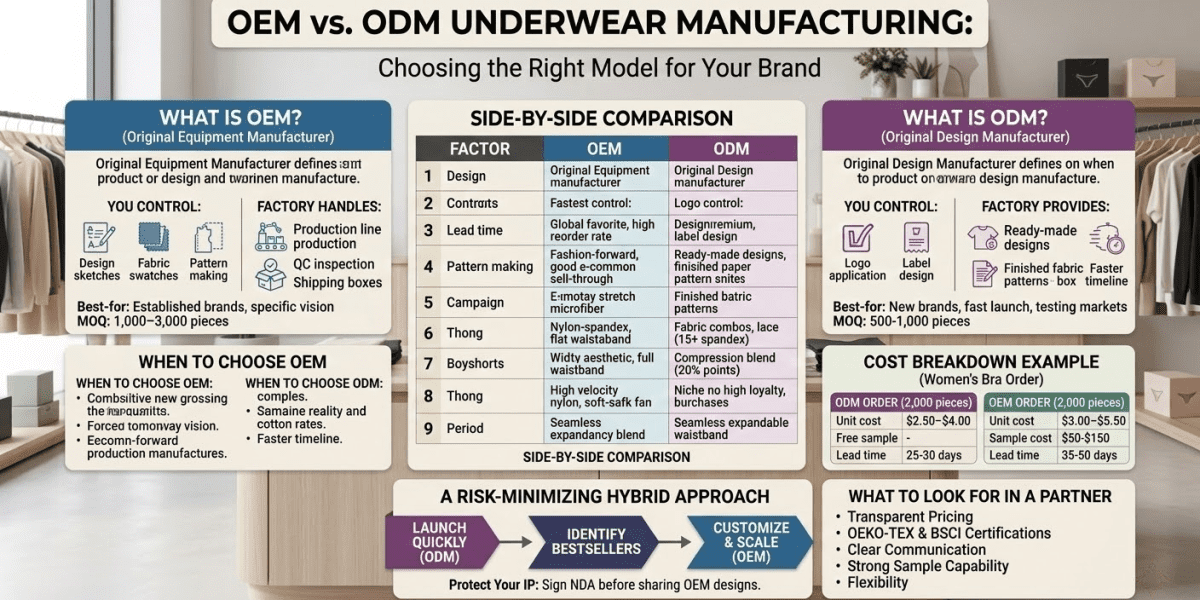
When exploring OEM ODM underwear manufacturing options for your brand, one of the first decisions you’ll face is which model to choose.
This article breaks down exactly what each model means, their pros and cons, and how to choose the right one for your business.
What Is OEM Underwear Manufacturing?
OEM stands for Original Equipment Manufacturer. In this model, you provide the designs, specifications, and tech packs, and the factory produces them for you.
You control:
- Design and patterns
- Fabric selection
- Colors and prints
- Sizing specifications
- Packaging design
- Branding and labels
The factory handles:
- Sourcing raw materials (based on your specs)
- Sample making
- Bulk production
- Quality control
- Packaging and shipping
Best for: Established brands with their own design team, companies with specific product visions, and businesses that need unique products not available from existing designs.
Typical MOQ: 1,000 – 3,000 pieces per style/color, depending on the factory.
What Is ODM Underwear Manufacturing?
ODM stands for Original Design Manufacturer. In this model, the factory already has existing designs and products. You select from their catalog and add your branding (logo, labels, packaging).
You control:
- Brand name and logo
- Label and packaging design
- Sometimes minor modifications (color changes, small design tweaks)
The factory provides:
- Ready-made product designs
- Established patterns and sizing
- Proven fabric combinations
- Faster production timeline
Best for: New brands that don’t have a design team yet, businesses that want to launch quickly, and companies testing new markets before investing in custom designs.
Typical MOQ: Often lower than OEM — some factories offer 500-1,000 pieces per style for ODM orders.
Side-by-Side Comparison
| Factor | OEM | ODM |
|---|---|---|
| Design ownership | You own the design | Factory owns the design |
| Uniqueness | Fully unique products | Shared designs (other brands may sell similar) |
| Development time | 4-8 weeks (sampling + revisions) | 1-2 weeks (designs already exist) |
| Cost per unit | Higher (custom development) | Lower (shared R&D costs) |
| MOQ | Usually higher | Usually lower |
| Design team needed | Yes | No |
| Speed to market | Slower | Faster |
| Brand differentiation | Strong | Limited |
When to Choose OEM
Choose OEM manufacturing if:
- You have clear product designs and tech packs ready
- Your brand identity depends on unique product design
- You’re targeting a specific market with unique sizing or style requirements
- You have sufficient order volume to meet higher MOQs
- You want exclusive products that competitors can’t copy
When to Choose ODM
Choose ODM manufacturing if:
- You’re launching a new brand and need products quickly
- You don’t have an in-house design team
- You want to test market demand before investing in custom designs
- Your budget is limited and you need lower MOQs
- You’re adding underwear as a category to an existing brand (like a fashion brand expanding into intimates)
The Hybrid Approach
Many successful brands actually use both models:
- Start with ODM to launch quickly and generate revenue
- Identify your bestsellers from customer feedback
- Switch to OEM for those bestsellers with custom modifications
- Continue using ODM for seasonal or experimental styles
This approach minimizes risk while building toward a fully custom product line.
What to Look for in an OEM/ODM Partner
Whether you choose OEM, ODM, or both, your manufacturing partner should have:
Strong sample capability — Can they turn around samples in 7-10 days? Are they willing to iterate until you’re satisfied?
Transparent pricing — Do they break down costs (fabric, labor, packaging) or just give a flat price? Transparency indicates honesty.
Certifications — OEKO-TEX, BSCI, and ISO 9001 are the gold standard for intimate apparel manufacturers.
Communication — Do they respond within 24 hours? Can they communicate clearly in English (or your language)?
Flexibility — Are they willing to accommodate smaller initial orders to build the relationship?
In-house design team — For ODM, check if they develop new styles each season. For OEM, check if they can help refine your designs.
Protecting Your OEM Designs
If you go the OEM route, protect your intellectual property:
- Sign an NDA (Non-Disclosure Agreement) before sharing designs
- Register your designs in your target markets if possible
- Include IP clauses in your manufacturing agreement
- Work with established factories that have a reputation to protect — they’re less likely to risk sharing your designs
Cost Breakdown: OEM vs ODM
Here’s a rough comparison for a standard women’s bra order:
ODM order (2,000 pieces):
- Unit cost: $2.50 – $4.00
- Sample cost: Often free or minimal
- Development time: 1-2 weeks
- Total lead time: 25-30 days
OEM order (2,000 pieces):
- Unit cost: $3.00 – $5.50
- Sample cost: $50-150 per style
- Development time: 3-6 weeks (including revisions)
- Total lead time: 35-50 days
These are approximate ranges — actual costs depend on fabric choice, construction complexity, order volume, and the specific factory.
Conclusion
There’s no universally “better” option between OEM and ODM — it depends on where your brand is today and where you want it to go. Many brands start with ODM for speed and switch to OEM as they grow.
The most important thing is choosing the right manufacturing partner. A good factory will guide you through either process and help you make the best decision for your business.
At TELIGE, we offer both full OEM and ODM services for intimate apparel. Whether you have detailed tech packs ready or need to browse our existing collections, our team can help you find the right path. Reach out for a free consultation.
Ищете надежного партнера по производству?
Получите бесплатную смету на ваш следующий заказ нижнего белья. Наша команда готова помочь.
Получить ценовое предложение English
  Arabic
  Spanish
  French
  Russian
  German
  Japanese
  Korean
  Swedish